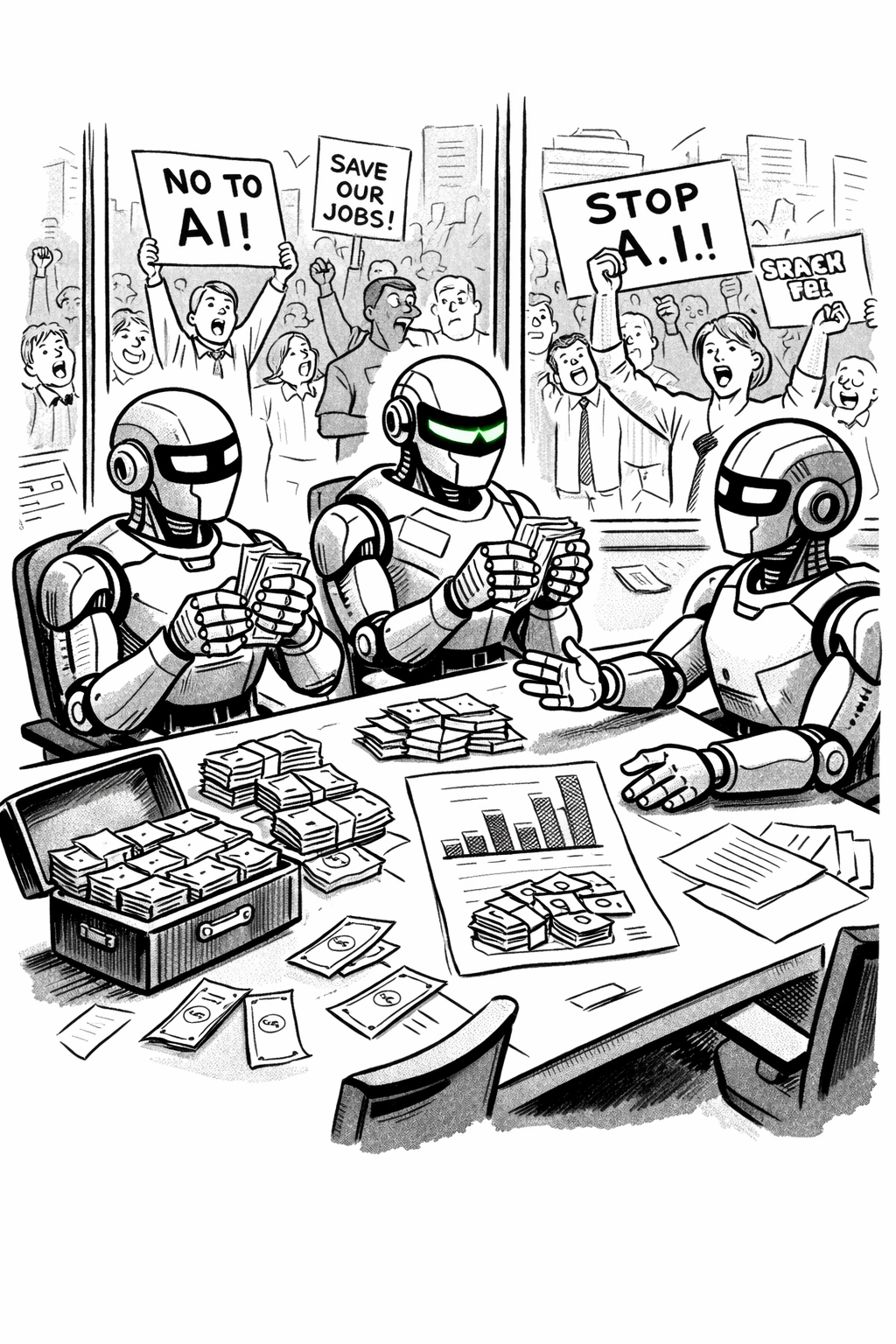
There’s been either a panic or a manic gold rush regarding AI, depending on who you talk to.
4% of GitHub public commits are being authored by Claude Code right now. At the current trajectory, we believe that Claude Code will be 20%+ of all daily commits by the end of 2026. While you blinked, AI consumed all of software development. pic.twitter.com/pFti4r6uR9
— SemiAnalysis (@SemiAnalysis_) February 27, 2026
Is software “over”? Maybe. So far they’ve started to contribute to software as a whole, at the cost of needing a few trillion dollars of extra data centers1. Not quite a fair trade yet.
Given the size of the investment, let’s ask a simpler question: what revenue would it take to justify the AI rollout, and what job loss would drive that revenue in the form of work “offloaded” to AI? Let’s do the math and determine if this is an apocalyptic scenario.
How much revenue does the AI sector require? About 4T$/year
Apple is a very successful company w/ (say) 300B/y revenue and 150k employees. Anthropic, OpenAI, and perhaps 3 others for good measure, would probably want to do that with their combined 15,000 employees (-ish, whatever).
Everyone else (AWS, Microsoft, etc) would love to justify their data center rollouts. McKinsey1 says to expect $7T over 4y for data center expansion. Call it $2T/y. 5 AI companies hitting Apple size would be another 1.5T/y in revenue that needs to come from somewhere. That’s 3.5T/y revenue that “AI” needs to make in order for the extremely bullish case to justify every bit of investment. Call it an even 4T$/y.
That’s a lot. We’re talking peak AI optimism here – five AI companies collectively rivaling FAANG, and all their hardware paid for before we consider the revenue needed to put them up there in the first place. All for 4T$/year. That’s extremely ambitious!
Where does this come from? About 20% of white-collar work but wait!
We were optimistic about revenue, but let’s be pessimistic about source of revenue. Let’s assume that every single dollar comes out of a worker or employer pocket (vs consumer-facing products like, I dunno, games, porn, chatbots, etc). This will show us the worst-case impact of the optimistic scenario above.
There’s 100m knowledge workers in the USA. 10x worldwide. Assuming avg cost to their employer is 100,000, this means there is 100T/y spent on white collar workers’ salaries. So AI needs to capture say 4% of white collar salaries to be spectacularly successful in 4 years.
How would they do this?
They could do this by capturing all work and charging 4% for it. This “100@4 scenario” would mean that AI companies manage to get all knowledge workers
fired, and they do the work in exchange for collecting just 4% of the salary
those workers were paid. This is actually the worst outcome for them, because
their operating costs are roughly determined by how much work they do! So
they’re incentivized to do as little work as possible and charge more for it
than the bare amount.
Conversely, they can try to capture 4% of the work (meaning 4% of workers are
laid off) at 100% of the salary (so the salary is just transferred to the AI
companies). They’d have to convince businesses it’s worth it somehow. Call this
the 4@100 scenario.
Of course the truth is somewhere in the middle. Let’s say they capture 20% of the work and charge 20% of the cost for it (20@20 scenario).
While all three result in the same revenue, 20@20 sounds nice, and is actually a really happy result. It’s worth remembering that “20%” might mean that all jobs lose 20% of their work, rather than 20% of all jobs are gone and the rest are unchanged.
What does 20@20 look like?
Consider an economy that is just 5 lawyers. AI companies would like to capture 4% of this economy to become the most valuable companies in the world, and also own the vast majority of computing power.
Option A: 1 lawyer can just be fired, replaced by AI that costs 20% of the salary, while 4/5 do their normal thing at normal salary. This is actually dumb. The other 4 gain no benefit and their coworker is unemployed.
Math: (0.20 * 1/5 = 4%)
Option B: 5 lawyers can pay 4% of their salary to AI companies, and in turn try to get their individual AIs to do 20% of their work.
Math: (0.04 * 5/5 = 4%)
In both these scenarios there’s 20% of the work going to AI to make up 4% of the total economy, but one is obviously really awesome! Suddenly the productivity is held by the employees, who decide to opt-in to a time savings which is disproportionate to the cost. What a deal!
This is pretty much how people use Claude in coding. Nobody is hoping their coworker is fired, they’re just enjoying slightly easier days and funnelling part of their takehome salary (or employer budget) to AI companies like Anthropic.
It’s like a CNC machine, not an “offshore worker.”
Bottom line: You don’t need an apocalypse
Maybe this is too optimistic. But recall, we’ve only analyzed existing work. There’s still a whole world of new work that AI can do, and a whole bunch of new industries and products that don’t exist that will need to be made, sold, and bought.
It’s absolutely absurd to assume all revenue comes from “stealing” salary, and that AI generates precisely zero net benefit other than automating existing jobs. So the real “capture” from salaries is probably much less than 4%. It’s also arguably absurd to assume that there will be five new top tech companies, usurping all the existing ones. Almost surely some of the AI revenue will come from (or be taken from) those companies, likely from competition.
To determine the ratio (how many jobs at what cost reduction), it’ll come down to what it costs to run the models to do the work, and I don’t think the 100@4 scenario works out technically, and it just seems better to target something like 20/20 from a publicity standpoint regardless. Everyone wins and GDP growth in the next 4 years can make up the job loss.
So no, I don’t think it’s going to capture all knowledge work. I think 20/20 is closer to the truth, with some industries (like mine) hit way harder than others over the next 4 years. But still, there’s a good 20/20 scenario where most people gladly give over a sizeable portion of their salary to alleviate a large chunk of work. E.g., Claude, my main squeeze. This is the “good 20/20” scenario that I’m looking forward to.
Comments
I have not configured comments for this site yet as there doesn't seem to be any good, free solutions. Please feel free to email, or reach out on social media if you have any thoughts or questions. I'd love to hear from you!