Let’s talk about this paper:
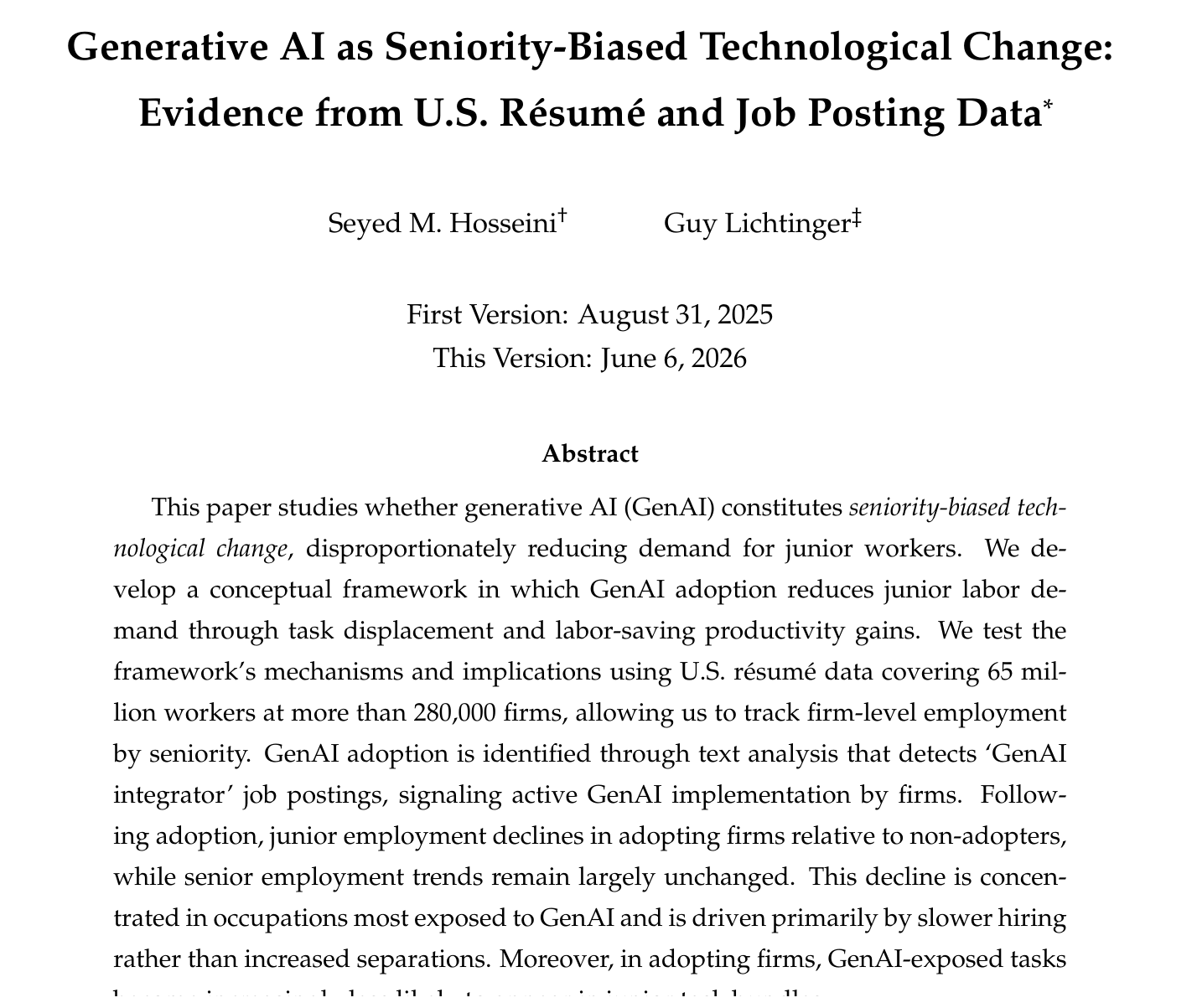
Seyed M. Hosseini and Guy Lichtinger, “Generative AI as Seniority-Biased Technological Change: Evidence from U.S. Resume and Job Posting Data” (SSRN working paper 5425555, first version August 2025, this version June 2026).
Brief aside about pirates
I just finished a book called The Invisible Hook (which you should read!). In it, we learn about pirate societies and tactis for signalling that aided their pursuit of wealth.
Here signalling is not lights / flags like you might find from maritime signals, but rather signalling intent, consequences, rationality, inevitability, strength, etc. Btw, the most excellent book on this is Strategy of Conflict which you also should read). The point of capital-S Signalling is to produce an inescapable result for your opponent by manipulating their beliefs in the viability of the options they have to avoid or win a conflict with you. In this case, how pirates cultivated a brutal, almost magically violent image so people would be reluctant to resist the capture of their ship.
Devs do this too.
In what might be my most “linkedin” post to date, I think Signalling explains a lot about use of AI in coding, hiring trends, and can help us predict some things about the future. For us, the important idea is that a signal is good when it is reliable and expensive to fake.
Let’s hold that idea in our heads while we talk about AI-affected hiring trends…
Back to the paper
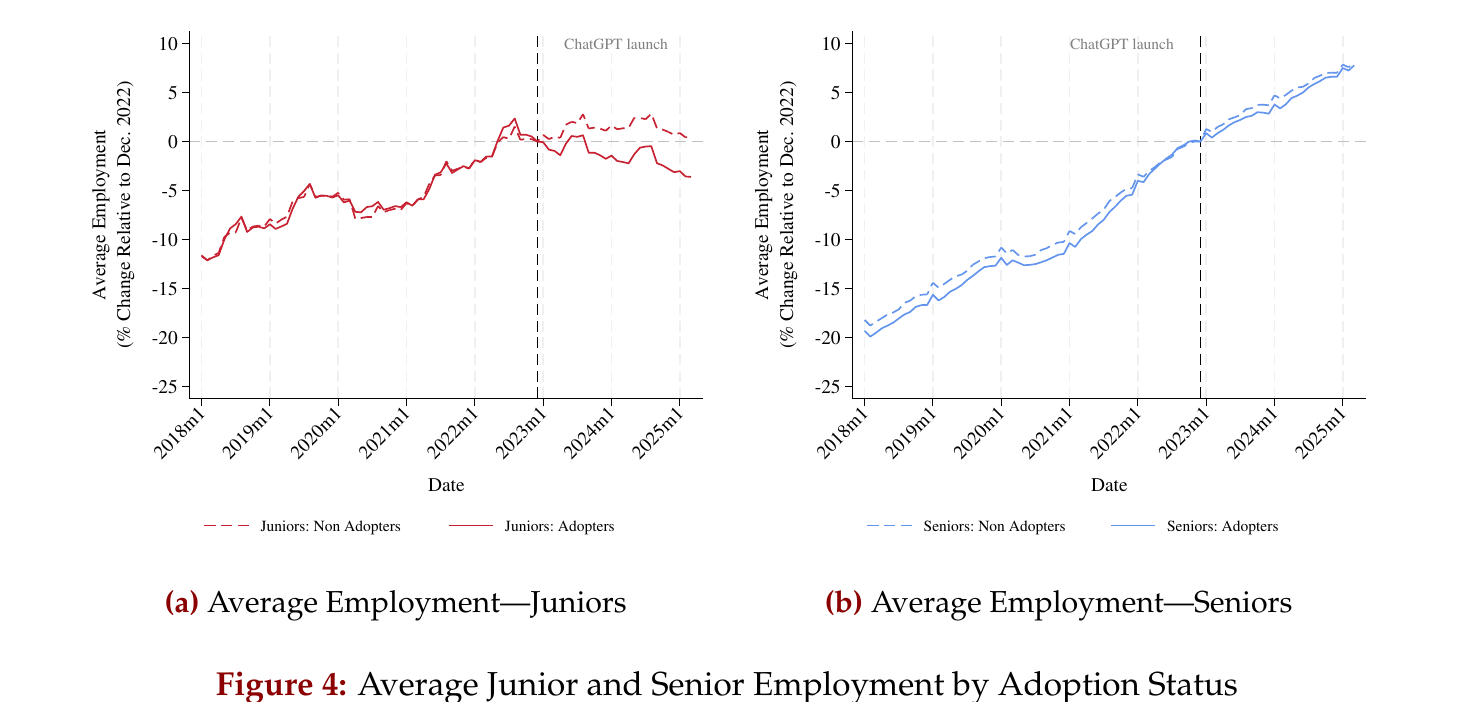
In this much-shared chart, we see that junior hiring stopped growing just as soon as AI started to become popular in software engineering. Their take, and the take of most the internet, seems to be that AI will produce job opportunities for people who can “manage” AI, especially applying “experience” and “taste”, and that juniors are “irrelevant” because AI can perform at the level of a junior.
The thing that throws me off this story is that it happened really quickly and quite broadly. The paper even finds this curious.
From the paper:
[T]he relatively early and pronounced declines—starting to emerge soon after the release of ChatGPT—may seem surprising, as automation impacts typically materialize more slowly. This suggests that the decline may not reflect immediate task automation but rather forward-looking adjustments by firms: the rapid diffusion of GenAI may have shifted firms’ expectations, leading them to scale back hiring for roles they predict will be automated in the near future, consistent with broader evidence on asymmetric employment adjustment (Ilut et al., 2018). We formalize this mechanism in a simple dynamic model in which expectations of future automation— combined with labor-adjustment costs—lead firms to reduce hiring today (Supplemental Appendix A.5).
So their take is that they can write a dynamics (physics?) model that shows this was an early anticipation of a changing industry.
Why this is dubious:
The story that everyone was going on vibes and closing their job reqs because they anticipated changing needs doesn’t ring true to me. People hire for existing needs, not because they are trying to generously build a better talent pool. The interpretation that AI was doing the jr’s work now also doesn’t make total sense, since this was very early, and I know from experience the models weren’t that good back then, and tooling was terrible. Still, it’s plausible that some jobs were frozen because teams decided they could do more with what they had.
What I think happened very quickly, is that AI diluted the hireability signals that people use to evaluate junior devs.
Consider an excellent junior candidate in software engineering:
- They have several github pages with active projects
- They can demonstrate a working system they have built
- They have good grades and a clean written communication style
- Their code is well structured, runs well enough, and uses some best practices
- etc.
A few prompts can produce all this, and I’m sure it does! There’s just no signal of effort, dedication, or talent anymore in the presentation of these things, unless you can prove you did it before AI. A new graduate probably cannot. A senior has a resume going back 5 or 10 years before it was possible to have these things for free.
So now it is very hard to evaluate a jr candidate for a job.
This difficulty would land precisely along the same axis as “AI Impact”: those companies that are using AI or are in an industry that AI can do “well” are going to have first hand experience with this problem - both seeing what AI can automate into existence, and being prone to candidates using AI to spoof their custom-tailored portfolios into existence.
And the paper buries this! Look at this in Appendix 3:
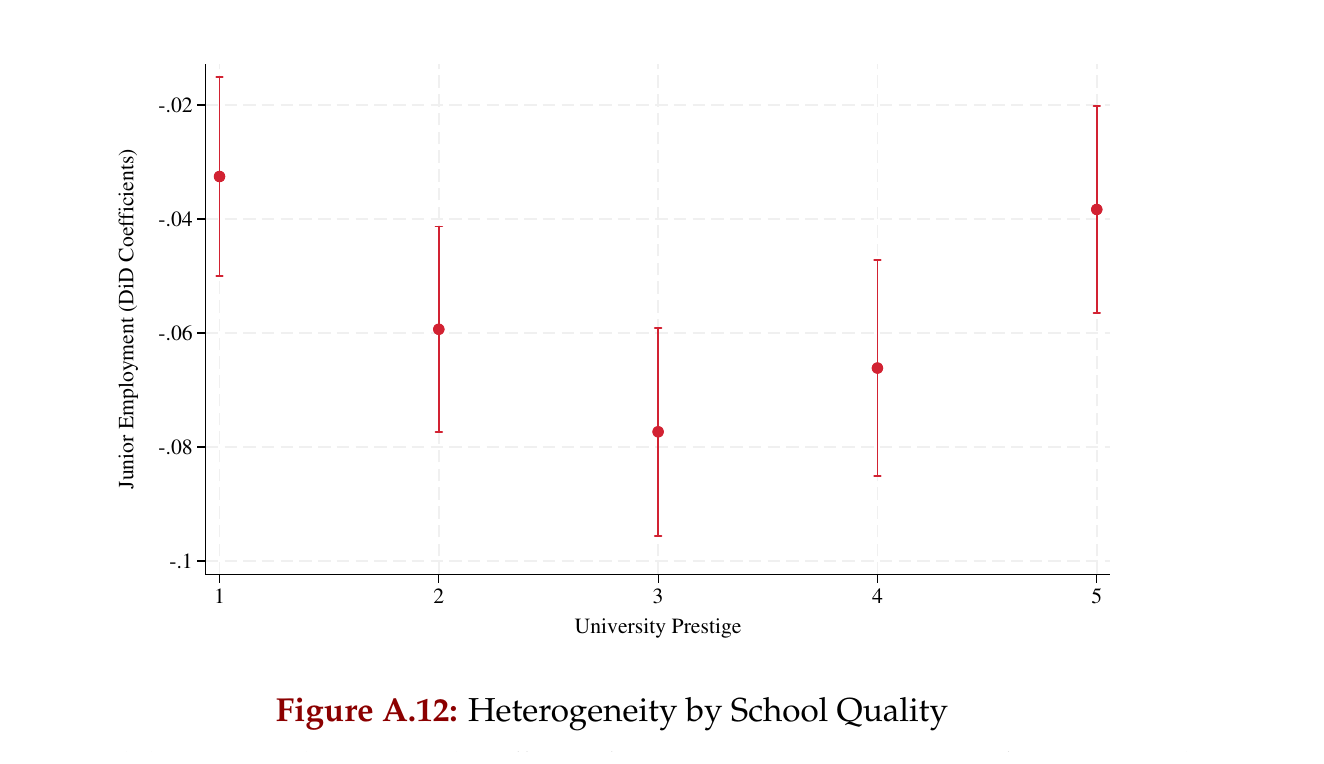
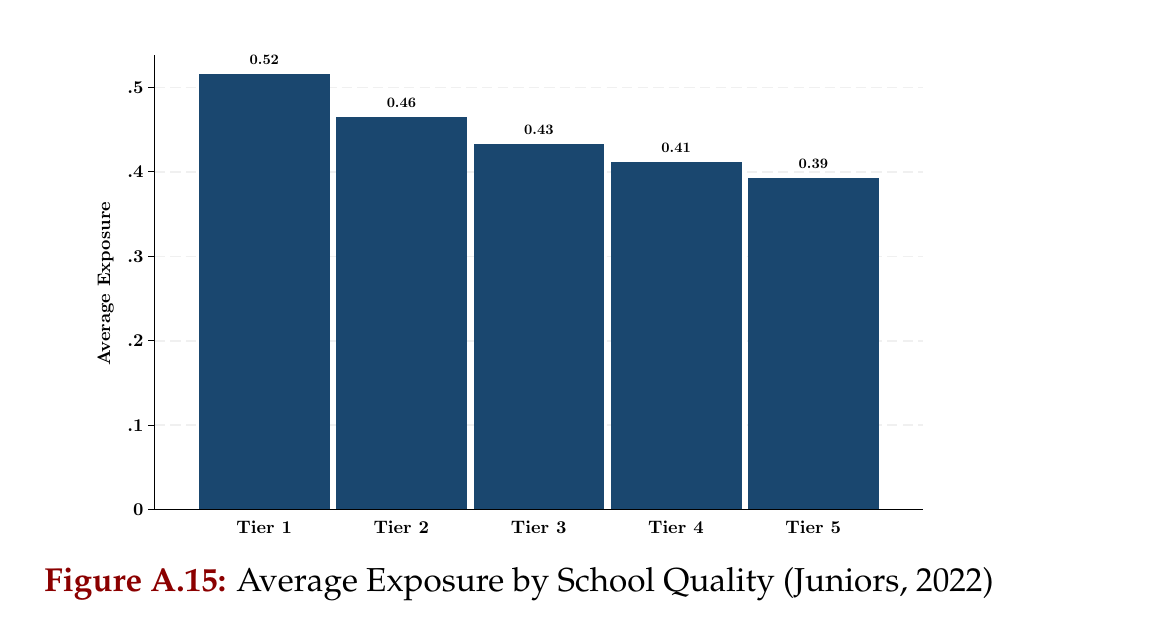
Combining these two, we find several contradictions that are not well explained by the prevailing thesis:
- jrs are hired less
- but the jr hiring slowdown is not evenly distributed.
- and candidates from top tier schools are not experiencing much slowdown, and are commanding high salaries (see A.13 in paper)
- and candidates from bottom tier schools are doing ok at getting into less-exposed occupations
The gap is not well explained in the paper:
AI exposure should lower employment prospects of all folks, so that top tier schools also suffer. If their AI-exposure thesis holds, then tier-1 should be worst, followed by 2, 3, 4, and 5 as increasingly less-bad. (maybe not straight line, but monotonic).
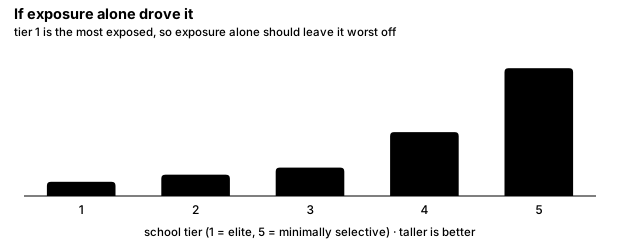
They admit this!
pattern may partly account for the attenuation in the decline from tier 3 to tier 5, but it does not help explain the increase in the magnitude of the effect from tier 1 to tier 3.
But try this: if you account for the signalling value of the school replacing the value of the student’s work, then you can still get into AI-affected jobs if you are coming from a top school. If you just go on school quality, you might expect a hirability score like this:
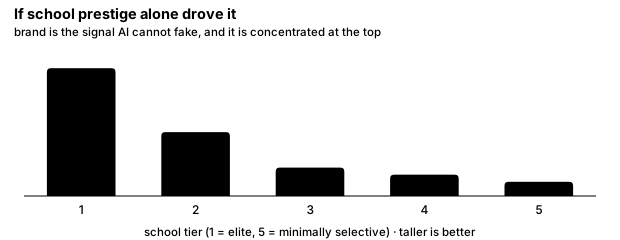
So adding those two signals: Prestige as a holdout hireability signal + reduced exposure as a decreasing risk profile…
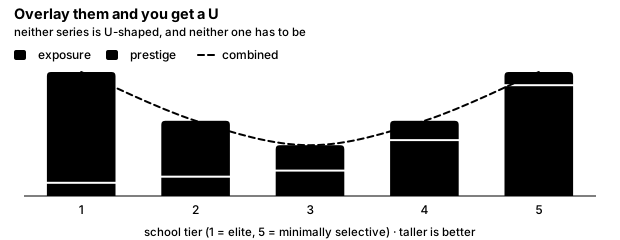
That’s a clean U-curve right? At least conceptually the idea that school signal is replacing portfolio / grades as a hiring signal can explain the top level flattening of junior jobs and the unexplained quirks of the paper.
My conclusion here:
- AI has diluted the signals available to hire Jrs in all AI-impacted fields precisely because AI can do the work*.
- Therefore, AI has reduced JR hiring broadly, because there just aren’t good indicators of employable qualities on candidates anymore (as opposed to Sr.s)
- But AI has reduce JR hiring narrowly where the signal is most ambiguous: The mid-tier and lower graduates heading into AI-affected fields.
- The predictive theory of this idea is entirely supported: When a jr can provide a good signal (top tier alma mater) or goes into a less-AI-impacted field, the hiring slow is mitigated strongly.
So, a reasonable explanation for the results in this paper is that AI removes effort and quality signals from producing a portfolio, therefore the value of a portfolio (disconnected from real work experience or other quality signals) plummets drastically. It’s a stacked deck against new grads, who rarely have work experience, and I think it explains the jr/sr hiring trends much better.
There are many apocolyptic implications of the interpretatino that AI is replacing jobs, namely that as AI improves, even the seniors will become irrelevant.
This is backwards. A junior dev now has a quicker onboarding, a faster orientation, and easier time managing ci/cd tooling or understanding system issues that drive their features. Having seen this first hand, I’m convinced this take is wrong and maybe even short sighted. It has produced a change in how you evaluate candidates, and nobody even knows what to look for anymore …
Comments
I have not configured comments for this site yet as there doesn't seem to be any good, free solutions. Please feel free to email, or reach out on social media if you have any thoughts or questions. I'd love to hear from you!