Arthur C. Clarke, 2001: A Space Odyssey (New American Library, 1968).
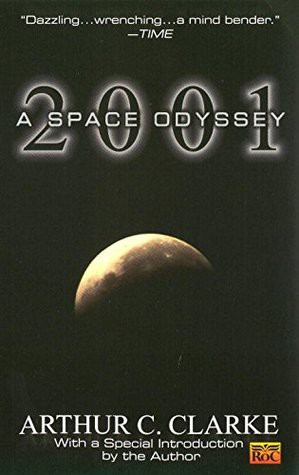
I read 2001: A Space Odyssey. I read it because I hadn’t, and I’m told the author is a genius. After all the heavy political stuff, I figured I’d back off and read something fun.
First up: Fantastic book. One of the best.
The foreword taught me something: The book was just a long draft of the screenplay. The movie wasn’t an adaptation like you’d expect, it was the end product1! As such, the book is remarkably close to the movie.
I’ll only mention a few impressions:
Wonder
Bottom line up front:
The central lever of the book and movie both, are wonder. They constantly make you think and try to expand you mind, showing you ideas you hadn’t considered. I want to emphasize, though probably not originally, that this was the goal of the monoliths in the book and movie as well. Their subtle manipulations caused the apes (and it turns out, many races) to learn and grow in their thinking by showing them new ideas.
This is arguably the point of scifi, and Clarke is very good at this. I normally listen to audio books, but more than once I stopped what I was doing and had to play back a whole expository or scene-setting chapter. I want to share one excerpt with you. In this part, the spaceship is near its destination, so it has to slow down to orbit. It will face away from Saturn and fire its thrusters to slow down in a way that brings it close to one of the moons.
There are just some things (like this) that the movie couldn’t do back then.
Even from its present 10 million miles, Saturn already appeared larger than the moon as seen from earth. To the naked eye it was a glorious spectacle; to the telescope it was unbelievable.
The body of the planet might have been mistaken for Jupiter in one of his quieter moods. There were the same bands of cloud, though paler and less distinct than on that slightly larger world, and the same continent sized disturbances moving slowly across the atmosphere. However, there was one striking difference. Even at a glance it was obvious that Saturn was not spherical, it was so flattened at the poles that it sometimes gave the impression of slight deformity.
But the glory of the rings continually drew Bowman’s eye away from the planet. In their complexity of detail and delicacy of shading they were a universe in themselves. In addition to the great main gap between the inner and outer rings, there were at least 50 other subdivisions or boundaries, where there were distinct changes in the brightness of the planet’s gigantic halo. It was as if Saturn were surrounded by scores of concentric hoops, all touching each other, all so flat that they might have been cut from the thinnest possible paper. The system of the rings looked like some delicate work of art, or a fragile toy to be admired but never touched. By no effort of the will could Bowman really appreciate its true scale, and convince himself that the whole planet Earth, if set down here, would look like a ball bearing rolling around the rim of a dinner plate.
(here I remove a discussion that would be a spoiler, concerning the rings)
Later …
The immense system of rings now spanned the sky and already the ship was passing over its outermost edge. As he looked down on them from a height of some 10,000 miles, Bowman could see through the telescope that the rings were made largely of ice, glittering and scintillating in the light of the sun.
He might have been flying over a snowstorm, that occasionally cleared to reveal, where the ground should have been, baffling glimpses of night and stars. As Discovery curved still closer toward Saturn, the sun slowly descended toward the multiple arches of the rings. Now they had become a slim silver bridge spanning the entire sky. Though they were too tenuous to do more than dim the sunlight, their myriads of crystals refracted and scattered it in dazzling pyrotechnics. And as the sun moved behind the thousand mile wide drifts of orbiting ice, pale ghosts of itself marched and merged across the sky. And the heavens were filled with shifting flares and flashes. Then the sun sank below the rings so that they framed it with their arches, and the celestial fireworks ceased.
A little later, the ship curved into the shadow of Saturn as it made its closest approach of the night side of the planet. Above shone the stars and rings and below lay a dimly visible sea of clouds.
There were none of the mysterious patterns of luminosity that had glowed in the Jovian night. Perhaps Saturn was too cold for such displays. The little cloudscape was revealed only by the ghostly radiance reflected back by the circling icebergs, still illuminated by the hidden sun.
But in the center of the arch there was a wide dark gap, like the missing uncompleted span of a bridge, where the shadow of the planet lay across its rings.
…
After their months of idleness, the main thrusters began to blast out their miles long cataracts of glowing plasma. Gravity returned, though briefly, to the weightless world of the control deck.
And hundreds of miles below, the clouds of methane and ammonia blazed with a light they had never known before, as Discovery swept, a fierce and tiny sun, through the Saturnian night.
At last, the pale dawn lay ahead, the ship, moving more and more slowly now, was emerging into day.
It could no longer escape from the sun, or even from Saturn, but it was still moving swiftly enough to rise away from the planet, until it grazed the orbit of Japetus, 2 million miles out. It would take Discovery 14 days to make that climb, as she coasted once more … across the paths of all the inner moons. One by one she would cut through the orbits of Janus, Mimas, Enceladus, Tethys, Dione, Rhea, Titan, Hyperion. Worlds bearing the names of gods and goddesses that had vanished only yesterday as time was counted here.
Then she would meet Japetus, and must make her rendezvous. If she failed, she would fall back toward Saturn, and repeat her 28-day ellipse indefinitely.
Note: The movie used Jupiter, according to the foreword, because the practical effects of the day could not do justice to these very visuals.
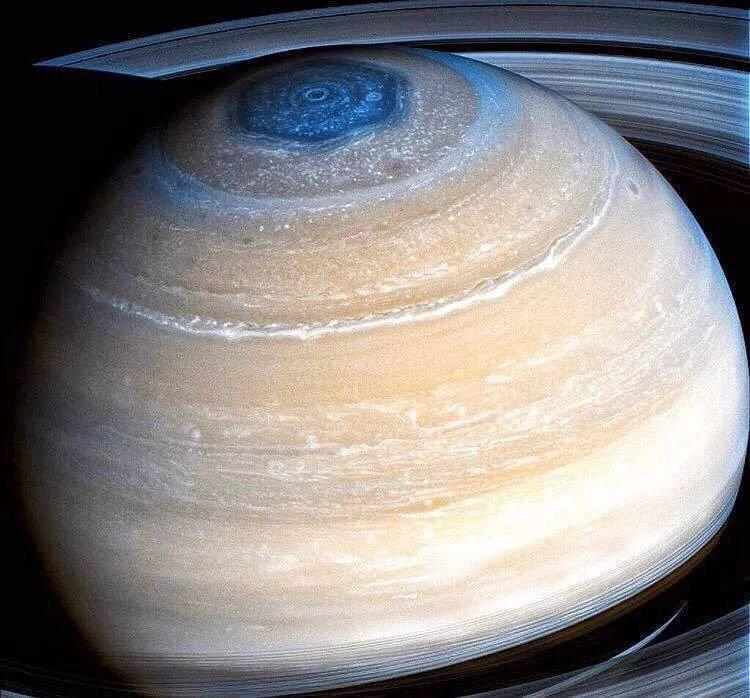
Saturn’s north polar hexagon and the rings behind it. Credit: NASA/JPL-Caltech/Space Science Institute (Cassini).
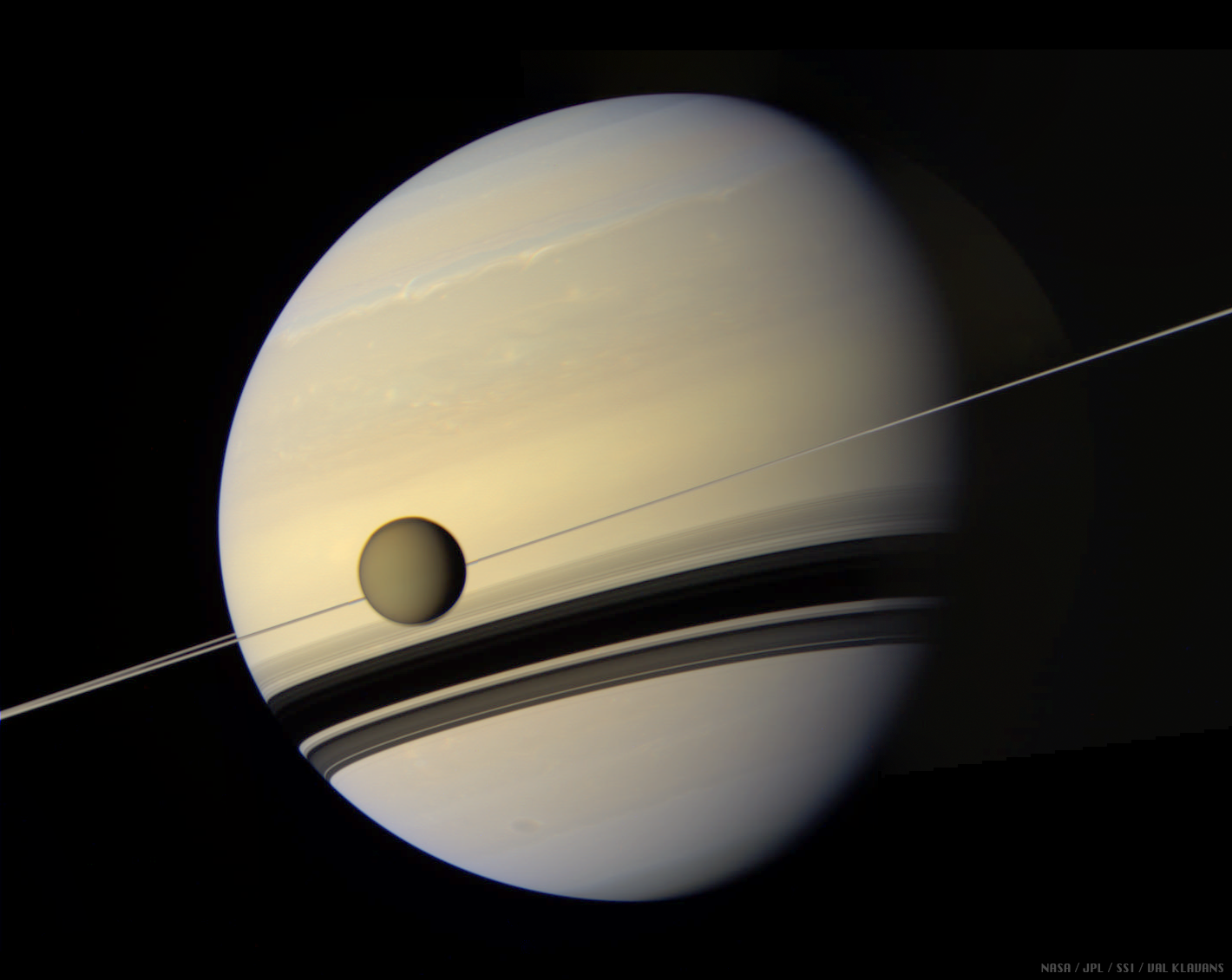
Titan against Saturn, rings almost edge-on, May 7 2012 – “all so flat that they might have been cut from thinnest possible paper.” Credit: NASA / JPL / SSI / Val Klavans.
Some 40 years later Cassini got us close up views of Saturn, and as beaufitul as they are, they they pale in comparison to this writing, imho.
The book has loads of this imagery. I loved it all.
The most visually striking part of the film was probably the ending. Sorry, spoiler alert: It is hard to parse. The book’s ending however is a journey like the above, but stretches on for chapter after chapter, touring various incredible astronomical locations in vivid detail, becoming more and more grand.
The whole book starts grounded, then layers wonder on layer of wonder until you feel exactly like Bowman, captured in something he can barely comprehend, throughout the final chapters. When Clarke does explain things he does so sparingly but directly, using forshadowing or a very limited narrator perspective.
Ending (spoiler)
The infamous ending of 2001 makes no sense in its visual context. The book is built on verbal exposition, so it makes much more sense! The original astronaut dies, but is reborn as an energy being. The same race of beings that made the monoliths, and the monoliths have a purpose - to elevate species all across the universe to the state that they, too, can become new “entities”. In fact, the book goes even further, and I won’t ruin the very neat ending. Suffice it to say, everything the movie did makes sense now that I’ve read the book, and I’m a little bummed they didn’t do the one final chapter in the movie!
Retrospective Accuracy
The tech portrayed in the movie was more prescient than the book’s descriptions. The infamous tablet scene2, for example, made more sense than the presentation of text newspapers in the book. Overall the space stuff was amazingly accurate. The zero g, talking about inertia, time delays, antenna alignment, even the detail that it was easier to move when air was removed, or the slight effects of atmospheric diffusion on vision. Clarke’s understanding and lay-friendly presentation of these details is unparalleled in popsci, perhaps only rivaled by Weir (The Martian, Hail Mary).
In 1968, this had to be a remarkable feat to make popularly accessible.
Science
What was so wrong was the prediction of things as-yet-unvisited. Clarke had to take a side on the “infinite dust” theory on the moon… and he hadn’t seen any of the planets or moons up close. He keeps referring to “tapes” and “recordings” in a quaint way.
Even the timeline of evolution has changed drastically since the writing of this book.
One of the main background stories of the book is overpopulation. This was a big concern back then, and the book flatly states that at 6 Billion people, the western world is rationing food, and people are starving, and dozesn of nuclear armed states are nearly at war.
But honestly, nothing is poorer for these gaps. The book is a remarkable timeless accomplishment, as is the movie.
Tech
Of course no revisiting of this book in 2026 would be complete without discussing HAL, the AI that controls the space ship. I think Clarke did an amazing job extrapolating neural-network based intelligent computers, right down to their evolution from Minsky’s original experiments.
And of course alignment would be the central issue. Of course conflicting commands would produce poor results. Of course an embedded computer trained to serve would waffle between obsequiousness and inhuman self-assurance. Of course Arthur C. Clarke saw it all coming.
If I had read this book even 5 years ago, I’d have laughed about how it took 5 seconds to respond, and that was an indicator of an internal quandary being resolved. How delightfully anthropomorphized I would have said. Pity those fools.
Yet today I routinely grow nervous when Claude takes too long to respond. It is indeed rerunning its alignment, checking results, forming an internal monologue to guide future decisions. All of it. It’s doing all of it.
What was so funny at this stage of my life, was hearing a few passages that sound so much like how software is sometimes created now that LLMs are here.
In one scene, the earth-based NASA is discussing a possible malfunction with the astronauts (this scene is in the movie, btw), and they say, up front, that they came to their diagnosis with aid of redundant copies of HAL on earth. To say this is pretty much how running code is analyzed - layers of LLMs trained to diagnose the outputs of layers of LLMs, is to admit that Clarke is rightly called a prescient genius.
Final thoughts
One thing that stuck with me is all of his pessemistic predictions are mostly false, and all of his optimistic predictions (esp of tech) were right. We could, albeit a bit more slowly than expected, produce a HAL-controlled fission drive spaceship to tour the outer solar system. Freezing ourselves hasn’t panned out yet, but nothing else in this book feels out of touch.
On the other hand the dismal state of the world does feel strange. An earth that cannot support 6 Billion? No way. Perhaps we are looming on the edge of nuclear war even now, but it certainly doesn’t feel as bad as what was portrayed.
I guess I wanted to take those two points as some sort of retrospective case for optimism, and compare to where we’re going, but I really can’t in good faith. We’ll see, but I wonder if we underestimate the time to a given technology, while simultaneously underestimating our ability to solve the problems we can see. Some optimism there.
I will be reading everything he wrote. This was Weir’s artistic parent, the better, more disciplined, and more intelligent, yet more patient and forgiving grandparent to all of Weir’s bedtime stories.
-
Yes, I wrote this whole thing myself, and I actually spit out that ChatGPT-ism on my own. ↩︎
Comments
I have not configured comments for this site yet as there doesn't seem to be any good, free solutions. Please feel free to email, or reach out on social media if you have any thoughts or questions. I'd love to hear from you!