Bhaskar Sunkara, The Socialist Manifesto: The Case for Radical Politics in an Era of Extreme Inequality (Basic Books, 2019).
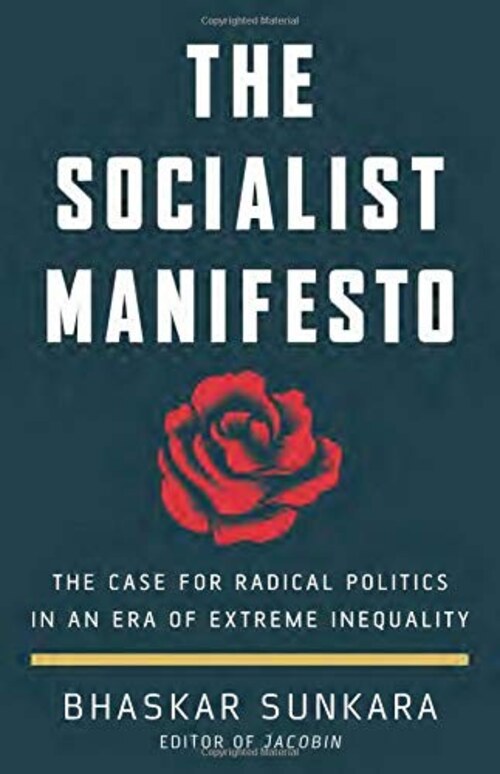
I’ve been requesting books on politics / political ideas that I would expect to disagree with. I think that if you can’t say why you disagree, you don’t disagree, you’re just opposed on vague vibes, and who wants to live like that (except everyone?).
Anyway, top of the list was what does justice look like, and second, this.
What the book does
The book essentially proceeds like this:
- Paint a rosy picture of what socialism could be, from the perspective of the working man
- Paint a dour picture of Capitalism, pointing to things like inequality and health care, especially in USA.
- Tell everyone socialism is a well-trod path (look at Norway!)
- Give a fairly comprehensive (and to my read, honest) telling of the history of socialism, including the major splits and historical attempts. This helps stage the modern agenda.
- Stage the modern socialist candidates, like Bernie Sanders, in light of the recent history
- Give a call to action and agenda for those who wish to help bring socialism about
My thoughts
It was great to see a consistent discussion of communism vs socialism vs reformed socialism vs democratic socialism etc. The main differences seem to be along the lines of how socialism comes about: Do we expect the workers to violently kill rich and powerful and follow a playbook, or do we expect them to democratically mobilize, or do we expect a government encumbered by its subjects’ needs to drift socialist over time?
It traces the rough schools of thought on this as follows:
| how it comes about | school | key figures |
|---|---|---|
| Armed seizure by a vanguard party following a playbook | Revolutionary socialism, later Marxism-Leninism | Lenin and the Bolsheviks |
| Win elections, then socialize capital from power | Democratic socialism | Kautsky and the SPD; Sanders and the DSA today |
| Regulated capitalism drifts toward welfare provision, capital never socialized | Revisionism, later social democracy | Bernstein; the Nordic model |
There’s really three issues I keep seeing when I examine these texts or ideas and nobody has a good answer for how they can be resolved (email me recommendations!). The first two I can discuss next. The third is really just opinion, man.
- Tapping wealth-creation engines seems reasonable to siphon off life support for socialist programs, but all-in socialism completely destroys it. Where does that come from in the future?
- There’s no acknowledgement that the underlying principle that drives socialism is one among many such reasonable choices of principles upon which to build a society.
- The “utopian dream” first chapter or two are actually horrifying. Without critical thought all of the following are proposed:
- Your coworkers will determine your wages
- Compensation will be based on credentials as much as performance
- capital asset taxes equalize profit across firms (no incentive to outperform whatsoever)
- Government boards allocate capital
- Banks nationalized
- etc…
And the TL;DR: I think there’s two things happening in the USA right now:
- Nobody wants socialism, everyone wants capitalism-funded social safety nets
- So, the socialists will promise to first get into power and then will (according to the book) follow standard playbooks to change USA into a socialist state, likely intentionally destroying what makes us rich in the first place.
OK, on to the two points we can discuss with details from the book.
1: Wealth/innovation
Even a basic read-between-the-lines brings up a tacit acknowledgement that I think everyone washes over: Communism/socialism, etc are predicated on a wealthy, innovative capitalist society. That is, you basically need to reach some level of wealth and relative inequality to create the motivation for socialist redistribution in the first place. That essentially requires wealth in the first place.
But then what? The book itself describes (essentially) a takeover of all the wealth-generating machinery, including (worst) the innovation engines. The book portrays innovation as coming from a state-owned investment / venture-capital fund. My friends, I’m sorry to tell you, there is no committee qualified to run a VC fund for even a single sub industry (that’s why so many competing firms exist), let alone an entire industry LET ALONE an entire country’s interacting industries and basic economy.
This idea is explored ad nauseum in other more economics focused books, my favorite of which is Constitution of Liberty (Hayek).1 I’m not a free market absolutist, but I do agree that prices and markets are an extremely valuable signal that drives innovation.
The idea that you can just cut off this signal seems so far fetched as to be complete fantasy. But at the same time I completely understand how one could think that, if only the right people with the right ideas got in charge of everything, then we could just solve all these inequality problems. It’s tempting! There are a few books here that go over how this went in USA.
Aside: after reading this book, revisiting my reading list and notes reveals this has essentially always been true. “Longitude” in particular is the story of state-sponsored competitions, not state funded research directions. Wealthy patrons took a mostly hands-off approach and “let the experts get on with it”, it’s precisely when experts – the proponents of one direction in particular – gain power that innovation stagnates as incumbants push down the natural competition. Go read about the travesty that is Alzheimer’s research circa 2020s)
- Constitution of Liberty addresses the idea of “special people” who can manage things better than distributed markets
- Mobilize goes over the history of the DoD/Pentagon attempting to use “special math” and “central planning” to build the military2
- Closer to my work, Hard Landing talks a lot about this same process and how it almost killed the airline industry3
The Wright brothers did not use government money, they made their money on a bicycle shop, spent $1000, and outperformed a Dept of War-funded attempt that had upwards of $70,000.
Thomas Edison built a private, profit-focused research lab and brought us record players, light bulbs, and the electric grid motivated only by profit.
Bell Labs brought us 10 Nobel prizes on everything from semiconductors to information theory, laying the foundation of the computing age. Even better, Bell was a private company that held a monopoly, and still reinvested profits in their resident geniuses to invent Lasers, solar cells, CCDs (digital cameras), and so on!
(The fact that the government sued and forced royalty free transistor sales for common good is not an argument for socialist takeover, it is precisely the kind of capitalist-funded opportunistic pro-social regulation that I’m attempting to argue for as opposed to total takeover)
It goes on. The cell phone was once a plaything of the wealthy. Now nearly everyone has one. Would a government “Cell phone equality” program work as well as a corporation’s desire to drive down production costs and expand the markets? Who knows.
So what about those currently successful socialist nations
Someone will vaguely wave towards Europe when discussing socialism. The smartest pro-socialist people I’ve talked to will steer away from this because these nations are not really socialist, but the association is plain to most Bernie supporters so it’s worth addressing.
The best examples are:
- Norway’s pension fund is funded by resource extraction and buys market equities
- Alaska pension fund is funded by resource rents
- Sweden’s Pension Funds
- Australia’s mandated 401k contributions have created $4 trillion AUD in wealth for their citizens, simply by forcing employers to provide 401ks with a match.4
What all of these have in common is that they are, effectively, capitalist money tapped and funneled into market-based solutions. Norway in particular is astounding - Norway’s pension fund owns 1.5% of all publicly traded companies worldwide, and contains 0.07% of the population. They have literally seized the means of wealth production!5
Those solutions that are not market based are actually already in danger of going insolvent and saddling future generations with terrible debt. Like our own Social Security (which would be much better as a 401k program)!
The social safety net programs of Norway & Australia et al suggest that socialist desires can be realized with large market-based programs
So what I have learned when talking with young and old USA socialists, and comparing what is written in this book, my overwhelming impression is that people don’t want to do away with capitalism and move towards socialism, they want a free capitalist society that funds social safety nets. I don’t think anyone would care that Elon Musk has a trillion dollars worth of businesses that he owns if those people could retire early, had their house paid off, had a good 401k, and had excellent health and disability insurance.
2. Principles
All throughout the history of socialism and attempts to bring it about are the coalitions of the downtrodden. These are the minorities or disenfranchised who band together to create the conditions for revolution, either peaceful voting or violent takeover or something else. But all these require a group of people motivated against another group within the same country. I.e., you need to have a strong sense of injustice and a firm line in the sand on which each person is sorted into oppressor and oppressed. This way of thinking is a prerequisite!
In the USA, we see these lines of class warfare explicitly in the left. Racism, Classism, etc all coalesce around a common hatred of a perceived rich and powerful class that either actively seeks to oppress them or simply supports a system that exploits them unfairly.
That the left champions this narrative no longer strikes me as a coincidence. The book’s presentation of the history marks this as deliberate, and the concluding “How we win” (Chapter 10) lays out this very thing as the correct course of action.
- identify inequalities and emphasize unfairness
- discuss explicitly the anger at “unjust outcomes of capitalism” (begging the question of if they are outcomes of capitalism per se)
- Rally around mass parties, foment an activist base and mobilize the working class
The fundamental argument behind all this is a sense of fairness In this world view, it is unfair that inequality exists at all. Fairness is set as opposed to inequality. When you believe above all else that equality of outcome is the virtue to be sought, then you must believe that inequality of outcome is therefore a bad thing. The opposite of good is bad, right?
Even if equality is the most important, the implication in all this literature strikes me as reductive to absurd levels: the socialist asks us to remake society entirely to artificially produce this unnatural outcome. Why is this unnatural? Because people are different. And here I reject the central unspoken assumption that they can and should be made equal.
The worlds hardest problems require the best people. Inequality (esp of wealth) is what enables big risks that will not affect the rest of us. It is probably true that inequality is necessary for innovation. And it is certainly true that innovation, even unequally distributed at first, has historically lifted masses of people out of hardship, sickness, and poverty.
Haidt’s Righteous Mind was really effective in dispelling this all-or-nothing logic for me.6 There are other virtues to build on, all which require a tradeoff explicitly. There is some alternative principle at play here. Either “Fairness” (you can keep the rewards you earn) or liberty (to take risks) or something else, that seems to cut against the definition of “fairness” (we all get a cut of the cake) that is proposed by Socialist Manifesto.
We got a little off course, but the main statement I want to make about the book, and the larger ideas presented in it, are that the explicit statement that inequality is wrong and unfair, is itself wrong. That the principle of fairness and justice implies that we must sort along classist lines is itself a false dichotomy.
Connecting to prior section, inequality enables and rewards risk taking. If inequality is not immediately wrong, much of the moral argument falls apart. And the fairness and justice that the socialists propose are already defined narrowly along the line toward a socialist revolution, and are not the only senses of fairness and justice worth having. And even still, fairness and justice are only two virtues that must be traded off in a complex society.
And if you’ll let me stretch even further, if you accept the dichotomy of oppressor and oppressed as presented with out critique, I’m still not sure anyone would be convinced we need to accept the solution proposed! A capitalist society can and should provide better social safety nets, and if it manages to, it will do away with much of the impetus for revolutionary change while preserving the essential virtues that it was built on. In that, I’m in total agreement with the book.
Aside: call to action
For those paying attention to recent DSA (Democratic Socialists of America) gains in elections, you should know, the book specifically condones this “promise much, get in power, reform from within” playbook. I am not going to tell anyone how to vote, but the “sneak in, tear it down” angle is historically accurate and explicitly called for.
Allup thoughts
There are a million different arguments for socialism, many that argue from one principle at the expense of others.
It is true that worker share of productivity growth has not kept pace with capital’s share. But, if you think about it, we’re both materially more wealthy than ever, and in a better position to “seize the means of production” than ever before thanks to the stock market. I’m not sure socialist policies did that. And anyway, it’s not the amount of time you spend on something that makes it valuable to begin with. The labor share of value is a stupid idea.
It is true that some people dominate wealth creation, but they were free to fail, and didn’t. No socialist ever gave me a job, my entire career has been working for folks who started a business at their own expense and agreed to share their money and stock with me.
This book is good. I recommend it. It helped me learn about the history, and (upon reflection) identify the governing principles behind socialist ideas. Of course it is attractive when one isolates those principles, but it becomes a more difficult sell when staged against other principles.
It is that forced tradeoff of principles that I think was the main benefit of reading the book.
Few claims mapped to the book.
| claim | what’s in the text |
|---|---|
| stagnant society, high inequality | Subtitle: The Case for Radical Politics in an Era of Extreme Inequality. Ch. 1 setup: productivity +25%, raise +13%; foreign competition squeezes margins; management automates; you work more with no input |
| latched onto that society | Transition is legislative reform + organizing over a generation. Bolted on, not built |
| vote-driven | Firms run by workers’ councils selected by a representative system; national transition via electing a left-populist president |
| government-controlled innovation | Capital-assets tax funds the investment pool; applicants judged on profitability, job creation, environmental impact; government officials do the judging. Banks nationalized. No interest rate |
| barely-competitive | Same tax transfers income from capital-intensive to labor-intensive firms so firms earn similar after-tax profits. Markets retained, payoff differential compressed by design |
| zero words for innovation | No mechanism for technical progress reported by any reviewer. Right-leaning review finds only the allocation problem: three criteria, no price signal, “it is unclear how government officials will decide.” Chapter’s closing beat: “work gets better, but it doesn’t feel as if something monumental has happened” |
Other reviews and resources
- Cato: capital-assets tax, allocation detail
- New Labor Forum: nationalization, pro-rated expropriation
- New Republic
I’ll probably read next:
- Economics of Shortage (1980)
- The Socialist System (1992)
- Road to Serfdom (1944)
- Das Kapital
-
F.A. Hayek, The Constitution of Liberty (1960), the “special people” argument is ch. 2, “The Creative Powers of a Free Civilization,” and ch. 4, “Freedom, Reason, and Tradition.” see also “The Use of Knowledge in Society”. ↩︎
-
Shyam Sankar and Madeline Hart, Mobilize (2026), McNamara’s “Whiz Kids,” was particularly fun to read about. ↩︎
-
Thomas Petzinger Jr., Hard Landing: The Epic Contest for Power and Profits That Plunged the Airlines into Chaos (1995). ↩︎
-
I dare you to compare the Austrialian 12% tax-to-401k program to USA’s 12% tax-to-social-security program. What a disaster SSC is. ↩︎
-
https://en.wikipedia.org/wiki/Government_Pension_Fund_of_Norway , accessed 2026 ↩︎
-
Jonathan Haidt, The Righteous Mind (2012). The six foundations: Care/Harm, Fairness/Cheating, Loyalty/Betrayal, Authority/Subversion, Sanctity/Degradation, Liberty/Oppression. ↩︎
Comments
I have not configured comments for this site yet as there doesn't seem to be any good, free solutions. Please feel free to email, or reach out on social media if you have any thoughts or questions. I'd love to hear from you!